Uma conversa sobre como a tradição chinesa tece a percepção no eterno
A modern English word points at a thing. A Chinese word participates in it — and then quietly rearranges the person who speaks it.
I’ve been learning this slowly, over years of friendship with Taiwanese families. Their language does not merely label reality — it weaves through it, each character touching color, season, organ, emotion, sound, direction, and virtue simultaneously. Where English gives you a node, Chinese gives you a node with edges running to everything.
In the language of hypergraph theory: a Chinese word has high connectivity. It sits at the intersection of many dimensions of perception — and because of that, speaking it doesn’t just communicate an idea. It coheres you.
智 — Wisdom
Even the writing system carries this.
Take 智 — the character for wisdom. It is built from sun (日), arrow (矢), and mouth (口). Read contemplatively, 智 suggests this: to be wise is to be illuminated, to perceive with correctness, and to name what has been seen. A single character. Three compressed insights. An entire philosophy held in one form.
I explored this more deeply in a previous meditation on 智, where I laid its three components alongside three verses from John’s Gospel.
This is the broader point: Chinese characters don’t just represent ideas. They are ideas — structured, layered, alive with internal coherence. The writing system itself is a web.
五行 — The Five Movements
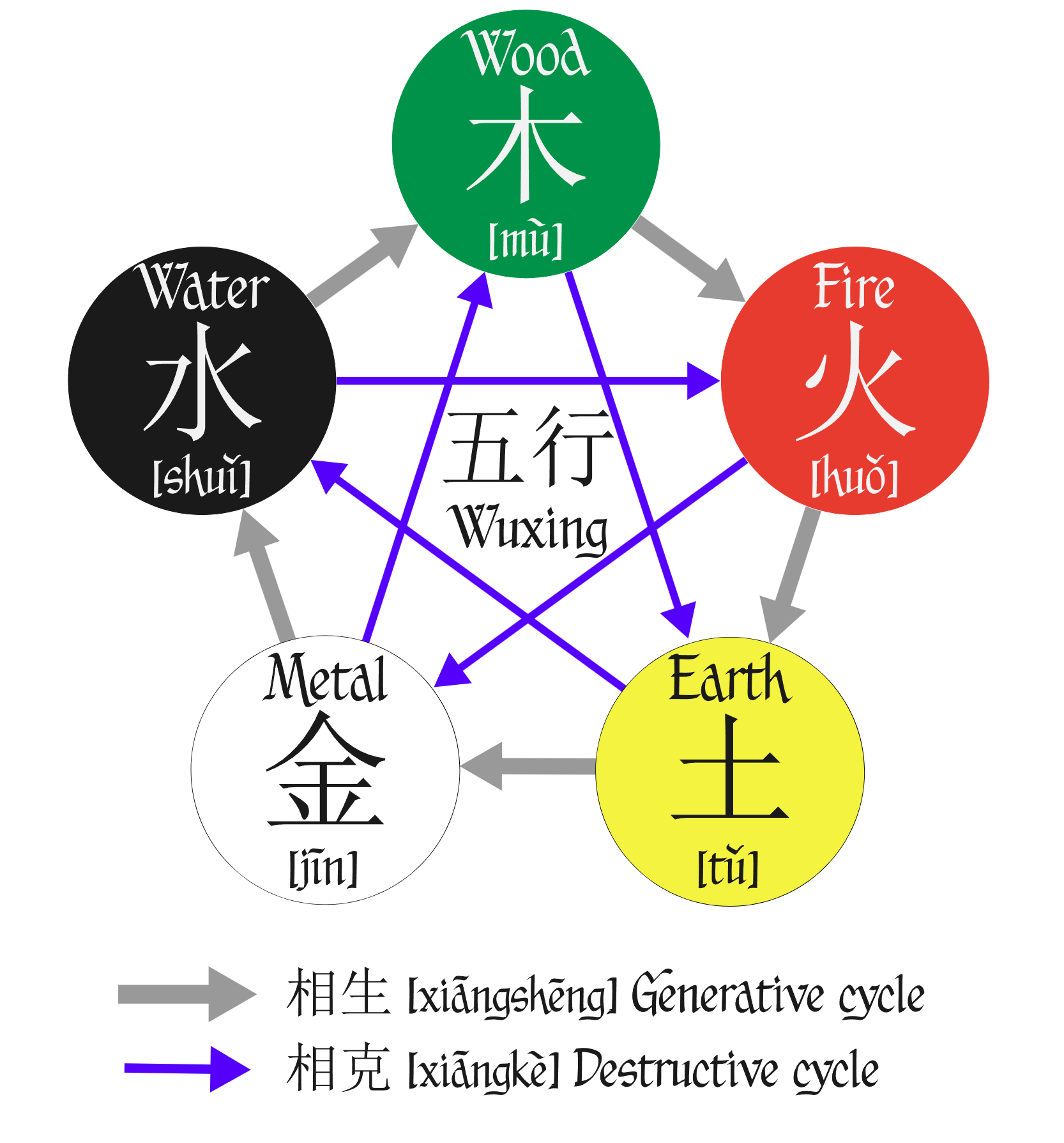
The Wuxing (五行) is a conceptual scheme that runs through nearly every traditional Chinese field of study — medicine, philosophy, astrology, music, martial arts, governance — to explain an astonishing range of phenomena through a single framework of five dynamic movements.
Most Western readers hear “Five Elements” and think of five substances — wood, fire, earth, metal, water — as if they were Greek building blocks. But 行 means movement, not element. The Wuxing is not a list of ingredients. It is a choreography of transformations.
The Weaving
Each movement entangles an entire field of perception into a single thread.
- Wood is spring, green, wind, the liver, anger, the eyes, sour taste, the sound of shouting, the direction east, and the virtue of benevolence.
- Fire is summer, red, heat, the heart, joy, the tongue, bitter taste, the sound of laughter, the direction south, and the virtue of propriety.
- Earth is the center, yellow, dampness, the spleen, pensiveness, the mouth, sweet taste, the sound of singing, and the virtue of faithfulness.
- Metal is autumn, white, dryness, the lungs, grief, the nose, pungent taste, the sound of weeping, the direction west, and the virtue of righteousness.
- Water is winter, black, cold, the kidneys, fear, the ears, salty taste, the sound of groaning, the direction north, and the virtue of wisdom.
The Knot
To a Western reader, this should feel disorienting. What does the liver have to do with spring? What does grief have to do with the lungs? Why would a color, a taste, and a virtue share the same movement?
And yet this is not arbitrary. These are observations — millennia of careful attention to how reality coheres at different registers. The Chinese tradition noticed that certain things resonate together, and built a framework to hold that resonance.
The result is a perceptual knot — a tight knot that ties together dimensions of experience the Western mind would never think to connect. And once the knot is tied, it holds.
The Self-Fulfilling Word
But here is what I think is truly genius.
Consider the color red. In the Wuxing, red belongs to fire — to the heart, to joy, to summer, to propriety (禮, lǐ). Propriety is the virtue of right relationship, of courtesy, of knowing how to honor the other.
Now watch what tradition did with this.
Red
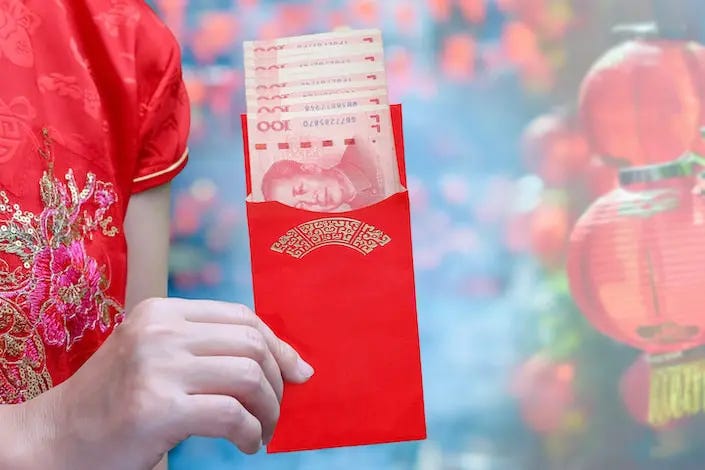
The red envelope — 红包 (hóngbāo) — is the vessel of courtesy in Chinese culture. You give it at New Year as a blessing. You give it at weddings as gratitude. You give it as reciprocity to those who helped you. Every act of courtesy, every gesture of thanks and honor — wrapped in red.
Over thousands of years, across billions of such gestures, the color red became saturated with the reality it was assigned to carry. Red no longer merely symbolizes courtesy. It has become courtesy’s visible frequency.
The tradition said “red is the color of right relationship,” and then performed that truth so faithfully, for so many generations, that the connection is no longer a convention. It is a fact — not because someone decided it, but because an entire civilization enacted it into reality.
Hearing More Than Was Said
This, I think, explains something I’ve noticed in my friendships with Taiwanese families.
Sometimes, in conversation, I felt they were hearing dimensions of what was said that I didn’t intend to convey. As if words, for them, naturally carry more edges. Their listening catches more threads.
The reverse was also true. My instinct was to pull threads apart — to follow one line of reasoning and see where it led. This is what a Western logical mind does: it untangles. And sometimes that untangling surfaced perspectives they hadn’t isolated, connections they carried implicitly but had never named separately. The exchange enriched both sides.
But I always sensed that my approach was, in some deep way, insufficient. To truly receive what they meant — not just a thread, but the whole knot — I would need far more context, far more cultural training, than a few years of friendship could provide.
This is a technology of language, refined over millennia, that trains the mind to perceive resonance across many registers at once — where the Western mind has become very good at achieving clarity through separation and sequence.
The Cross on the Ground
I have seen this technology at work — not in a textbook, but in a community.
The Taiwanese families I know belong to the Tao community in South America — a tradition brought to Brazil that integrates Taoist wisdom with other spiritual traditions, including Christianity.
In traditional Chinese pedagogy, the Wuxing is drawn as a circle with a star inscribed inside it — the outer ring tracing the generative cycle, the inner star tracing the controlling cycle. Five points, five movements, all in rotation.
The Tao community teaches it differently. They present the Wuxing as a Cross.
This is not how it was taught in China. It is a bridge — and one that flows both ways. The Chinese framework is reread through a new center. The Christian symbol is set within a cosmology.
土
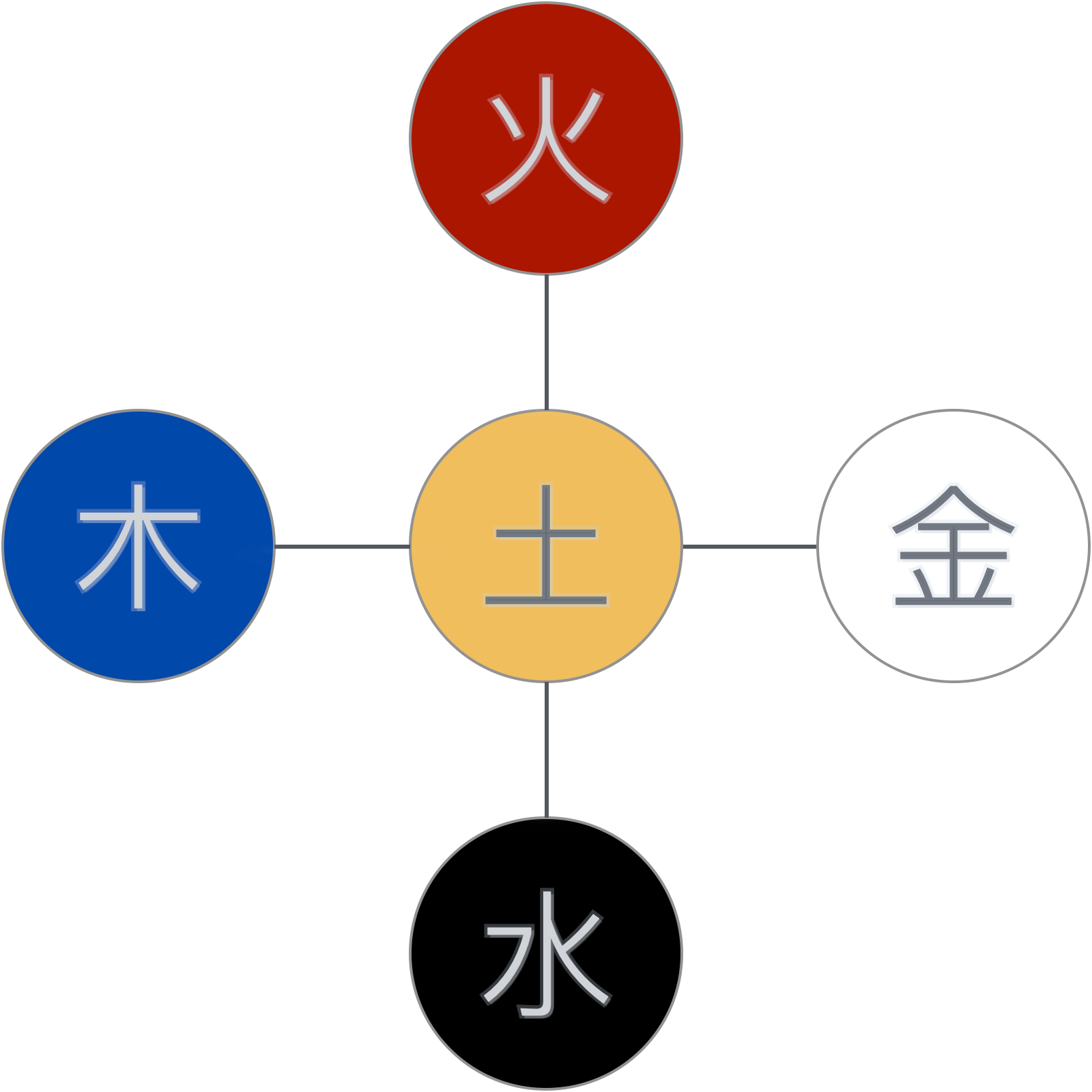
In the Wuxing cross, Earth’s position is the center. And its character — 土 (tǔ) — is a cross standing on the ground.
They teach it this way: Earth’s virtue is faith. You can rely on the ground. It is firm. You root in it. Earth is stability, the still point around which all transformation revolves. And if you lose your faith, you lose your ground.
I wrote earlier about the audacious decision to translate John 1:1 as 太初有道 — “In the beginning was the Tao.” Missionaries in China heard the Tao and recognized the Logos — a bridge built in language. Missionaries in South America saw the Wuxing and recognized the Cross — a bridge built in geometry, requiring no translation at all, only the eyes to see that the shape was already there.
Some words do not point. They gather.
太初有道。In the beginning was the Tao.